
1 May 2026
Three generations of football from one team in Germany
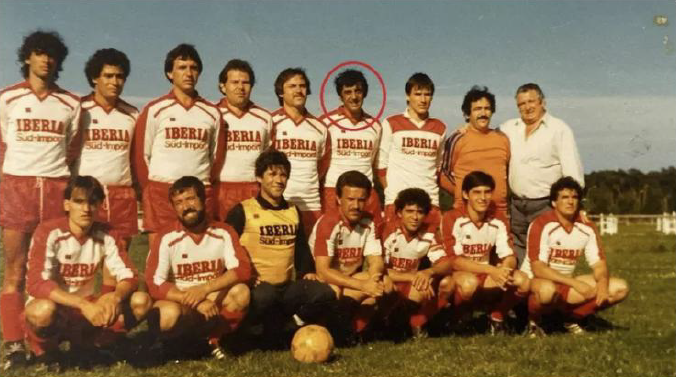
Delfín Fernández, originally from Ponteareas and who emigrated to Karlsruhe in the 1960s, founded FC Español. Since 2011, his son Abel has served as president of the club, while his grandson Noel is a player on the team.
Just over 100 kilometers north of Freiburg, where Celta recently began bringing its European adventure to an end, lies Karlsruhe. As everywhere in Germany, football occupies a central place there. Not only because of the main club, currently playing in the 2. Bundesliga and once active in European competitions — in 1993 they defeated Valencia CF 7–0 — but also because of the many small clubs that complete the local football ecosystem. One of them is FC Español. Its very name reflects its origins, and its history is shaped by a family tradition rooted in the parish of Xinzo, in Ponteareas.
From there, Delfín Fernández set out more than half a century ago to build a life in Europe. His journey led him to Karlsruhe and to a club that had been re-founded in 1962 by several fellow countrymen. He was a player, an official, and eventually the influential president who transformed a group of friends into an officially registered club. That dedication continued with his son Abel, who also played in his youth and has served as club president since 2011. The saga continues with Noel, who now plays as a right-back for the team.
“My father loved football and the club: he spent almost 40 years at Español, and everything I do here is for him,” says Abel Fernández, president of Español and Delfín’s son.
Delfín passed away in 2021. His 55-year-old son keeps his legacy alive in the club offices, while his 25-year-old grandson carries it on the field. “Being president is a responsibility,” Abel admits. He has no intention of giving up the important legacy left by his father. “He loved football and the club. He was there for almost 40 years,” he explains. The current president lives surrounded by memories inseparably tied to a club that has become almost a life project for him.
Abel took his first football steps in other local structures, since Español did not yet have youth teams at the time. But as soon as he reached senior level, he joined the club of his heart. “And I brought my friends with me,” he emphasizes.
Back then, the Spanish community in Karlsruhe was very large, and football served as a strong social bond between emigrants, their descendants, and the local population. “The ground had a restaurant, and lots of people came together on weekends,” Abel recalls. This atmosphere was complemented by a yearly festival that attracted huge crowds. “Around 6,000 people came each day during the three-day event. There was paella, calamari… all of Karlsruhe knew about it,” he says. All the proceeds went directly to the club.
Those were good times. So good that Español rose through the ranks in the second half of the previous decade — already under Abel’s presidency — reaching the level of what was then the third division. They even came within one victory of playing Bayer Leverkusen in the German Cup. “Those are incredible experiences for us; we’re a neighborhood club with only 50 members,” Abel says, recalling Sirus Motekallemi, the coach at the time, now assistant coach at Karlsruher SC.
But everything passes. Like many other clubs, Español was hit hard by the COVID-19 pandemic and by a lack of financial support. Today the club plays in the second-lowest division in Germany, with a reserve team in the very bottom tier. “But we are financially healthy,” the president assures. His son Noel continues the family tradition on the pitch. “When I watch him play, I see my father again. I know how proud he was that I played for Español. Now it’s the same,” Abel says.
That sense of belonging is also deeply present in the third generation. “I’ve spent every Sunday of my life at the football ground because of my grandfather and my father. Español is more than a club to me,” says the young right-back in perfect Spanish. “Football connects me to my roots. Besides, we always went to Galicia during holidays,” explains Noel, who considers himself Galician: “Of course. I don’t speak the language perfectly, but I understand it very well.”
That connection also carries the sky-blue colors of Celta. Delfín’s grandson inherited his grandfather’s passion for Celta de Vigo and traveled with friends and family to Freiburg to watch his team. “At his house there were no cartoons on matchdays — only Celta,” he recalls laughing, before his smile fades while remembering what happened at the Europa-Park Stadion. Football things.
All these football ties became visible when Abel and Noel shared the same shirt, pitch, and dressing room. “My father played some matches with my grandfather, and a few years later I got to do the same with him. That was really special,” says Noel, the third link in the Fernández family chain. His father is proud — of that experience and of how much his son enjoys the club. “I love watching him play with all his friends,” he says. “Here it’s normal that every summer seven or ten players leave and the same number arrive. But we’ve kept the same core group together for eight years. That’s the best thing about football: building community.”
“I’ve spent every Sunday of my life at the field; for me Español is more than a club,” says Noel Fernández, Español player and Delfín’s grandson.
That is what Abel fights for. “If I don’t take care of it, the club stops existing,” he says sadly. “You have to pay for pitches, referees, federation fees… the club costs €25,000 a year, and someone has to finance that.” Friends help through sponsorships, “but you have to keep going, otherwise it all disappears.” He also mentions vice president Ralf Gerner, a German with perfect Spanish and great commitment to the cause — a cause that remains alive.
Noel is still too young to think about succession. That time will come. Meanwhile, Delfín’s legacy remains very present. “My father told me to stop and stop spending money. But my heart won’t let me,” Abel confesses, summarizing his motivation in one sentence: “I do everything for him.”
At that moment, the memories return, pride takes shape, and all the effort becomes worthwhile. Because nothing truly dies as long as it lives on in people’s hearts. That is why FC Español is still very much alive — in Karlsruhe and in Ponteareas. Thanks to three generations from the banks of the Tea River continuing their football story in Germany.